About Ψ Lab
In the first generation of computing devices, mainframes and personal computers were used primarily for data management and processing, following a set of predefined rules. Input devices designed specifically for interacting with these systems provided a deterministic mechanism for identifying the user’s intent. For example, when a mouse is moved or a key on a keyboard is pressed, the system receives this information with high certainty. The next generation realized—and perhaps continues to realize—the vision of ubiquitous computing. Portable devices of various sizes, such as smartphones and tablets, used at different times and locations, gave rise to applications that utilized available information about the context of the interaction to present relevant information to users on 2D displays. How we interact with these systems, including pen and touch input, has also moved away from stationary input devices toward interactions that more closely resemble how we manipulate physical objects.
Today, in the era of spatial computing, computation is increasingly distributed and situated in our surrounding environment. Wearable devices, such as augmented reality (AR) headsets and lightweight AI glasses, take the notion of “display” from a 2D screen to digital information that can be presented through multisensory channels (e.g., visual, auditory, tactile) at any time and within its real-world context. We are also increasingly surrounded by physical AI systems, such as autonomous mobile robots, that need to make inferences about people’s intent while operating in unseen environments. This generation of computing introduces greater complexity and uncertainty, posing new challenges beyond previous paradigms.
At Princeton’s Situated Interactions Lab (Ψ Lab), we tackle these challenges by studying and leveraging existing theories of human perception and cognition. Our goal is to build interactive technologies that are closely integrated with the world around us and create new opportunities to extend our abilities and augment our intelligence in situ.
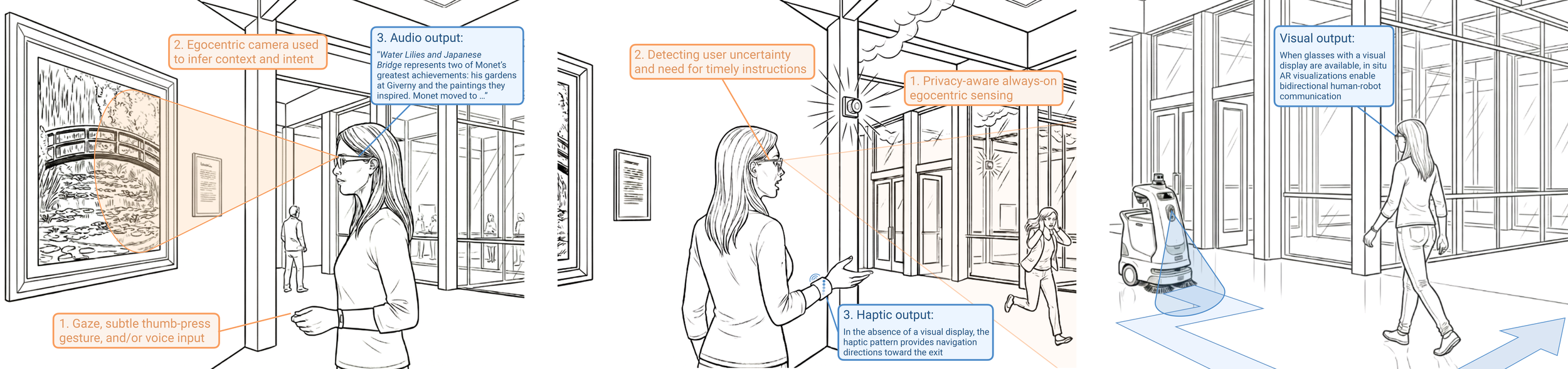
Our research falls under three broad categories:
On the user input side, we facilitate embodied interactions and interpret users’ low-effort multimodal communication, providing mechanisms to resolve ambiguity.
On the system output side, we aim to infer users’ implicit needs as they act in the world and intelligently present timely, minimal information in an appropriate representation and sensory modality.
Finally, we explore new human-robot interaction paradigms to achieve symbiosis between humans and robots in physical spaces, facilitating shared mental models and increasing communication bandwidth.
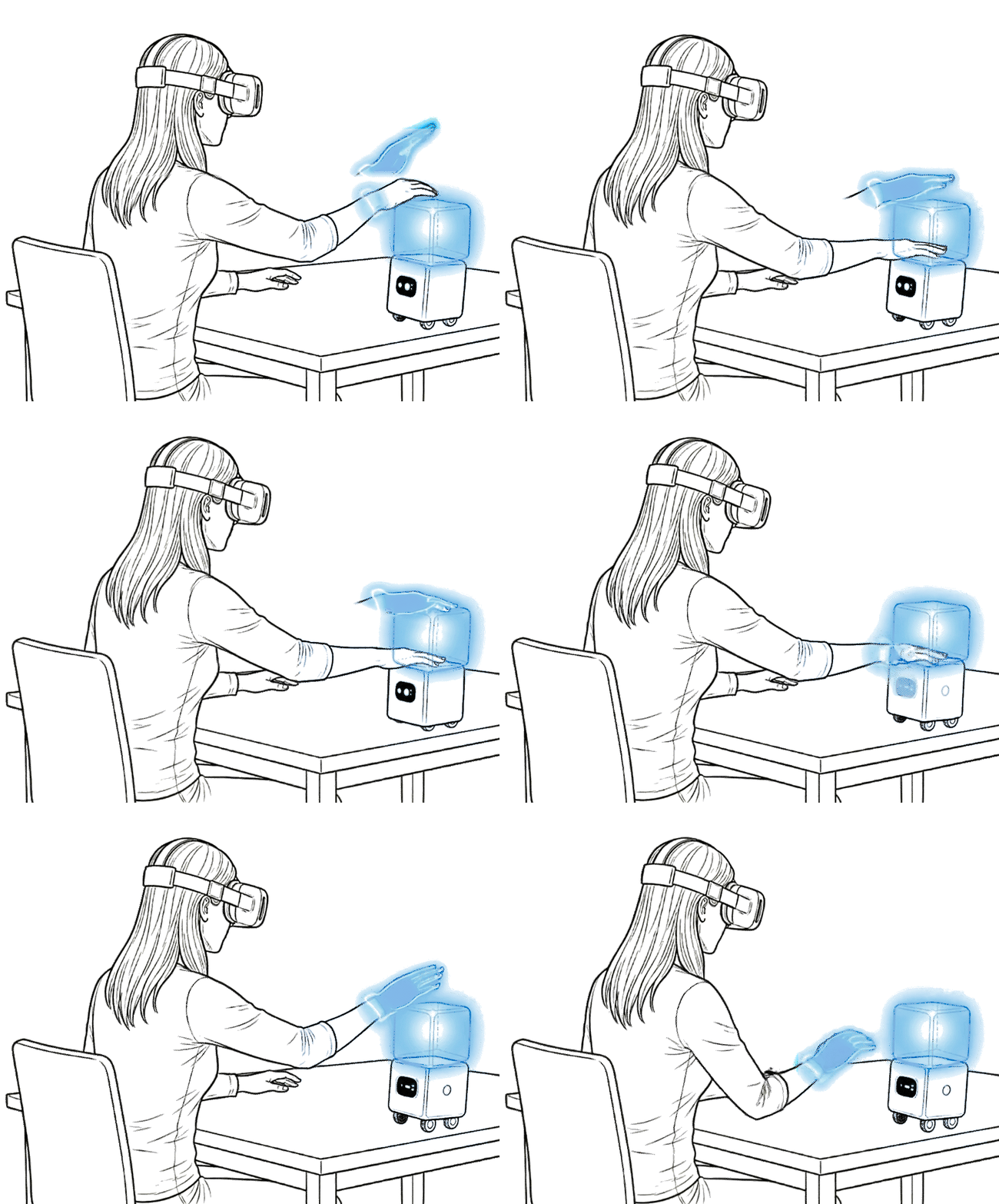
Our research focuses on lightweight wearables (e.g., AI glasses with minimal or no visual displays), but we also pursue a narrower line of work using VR and passthrough AR headsets. Grounded in sensorimotor control theory, we explore illusory interactions, which use subtle, unnoticeable sensory mismatches to enhance user experience (e.g., improving the perceived performance of haptic devices), and beyond-real interactions, which use noticeable but adaptable sensory mismatches to extend human abilities (e.g., walking at faster perceived speeds).
Applying to Princeton HCI
If these research directions interest you and you’d like to apply to join Ψ Lab and the broader Princeton HCI community, please read the information below.
-
Unfortunately, I don’t currently have any positions for high school students. If you email me, please know that you will not receive a reply. This is not a reflection of your abilities – I simply don’t have the capacity to respond to the volume of requests.
-
Princeton’s CS MSE program is highly competitive and offers full financial support through Teaching Assistantships (see up-to-date information here). The admission process is centralized at the department level, and decisions are not made by individual faculty. However, if you’re hoping to do research with me as part of your thesis requirement, you’re welcome to mention my name in your statement; no need to email me. Once you’re accepted, I’d be more than happy to discuss potential research involvement in Ψ Lab!
-
If you’re interested in joining Ψ Lab as a PhD student, please apply to the Princeton CS PhD program, choose “Human-Computer Interaction” as your research area, and mention my name in your research statement so your application reaches me. There is no need to email me separately, and it’s unlikely that I’ll respond.
Are you looking for PhD students?
Yes, I’m looking for 1–2 PhD students to join my group.
What should I include in my statement?
Describe your past research experience, the contributions you made to each project, and any technical systems you built or evaluated. Also include your research interests and the types of projects you hope to pursue during your PhD.
How do I apply?
Princeton CS admissions information: https://www.cs.princeton.edu/grad/admissions-requirements
Frequently asked questions: https://www.cs.princeton.edu/grad/faqWhat should I expect after I apply?
For selected applicants, I conduct multiple rounds of Zoom interviews in the weeks following the deadline, so be prepared to reply promptly to my email (within a week for Round 1 and a few days for Round 2) and sign up for a slot if I reach out. -
I don’t currently have any positions for visiting researchers or summer interns. If you’re a PhD student or postdoc with funding from your home institution and would like to join my group in person at Princeton, feel free to email me with the subject line “Funded Visiting Researcher from [your home institution].” In your email, describe why you would be a good fit for my group, the duration of your proposed stay, and the support you have from your home institution. Please also include your CV and a link to your website. I will respond based on fit and my bandwidth to host you.
-
I am looking for HCI researchers to join my group as postdocs. Feel free to email me with the subject line “Postdoc Interest.” In your email, describe why you’d like to join my group, and include your CV and a link to your website. If we’re a good match and I still have an opening, I’ll follow up.